Brazil is a country of continental dimensions, with a highly digitalized population. To understand the scale of this market, consider that the internet reaches 74.9 million households, according to data from the National Household Sample Survey (PNAD). This means that 93.6% of private households have internet access. According to IBGE, the Brazilian Institute of Geography and Statistics, the country's population is estimated at more than 213 million inhabitants.
These figures are particularly relevant for companies evaluating Brazil as a potential market for business expansion.
However, it would be a mistake to assume that broad, mass-market digital communication strategies alone are enough to succeed in the Brazilian market. A different approach is required: investing in audience segmentation through an effective local marketing strategy.
In this article, we will explain why adapting to the Brazilian context is essential for Italian companies looking to enter Brazil through digital marketing initiatives.
Local Marketing in Brazil: Cultural Adaptation Comes First
The main difference between Italian and Brazilian marketing campaigns lies in their communication style. While Italian advertising tends to place greater emphasis on aesthetics, storytelling, and brand positioning, Brazilian consumers respond more positively to messages that are direct, emotional, and action-oriented.
This does not mean abandoning a brand’s identity; rather, it means adapting it to make it more effective within the local cultural context.
In Brazilian local marketing, campaigns that highlight tangible benefits and create a genuine connection with the audience have greater engagement potential. Brazilian consumers tend to reward brands that “speak their language” — not only in linguistic terms, but also through their communication style and the channels they choose to use.
Digital Channels and the Brazilian Consumer Decision Journey
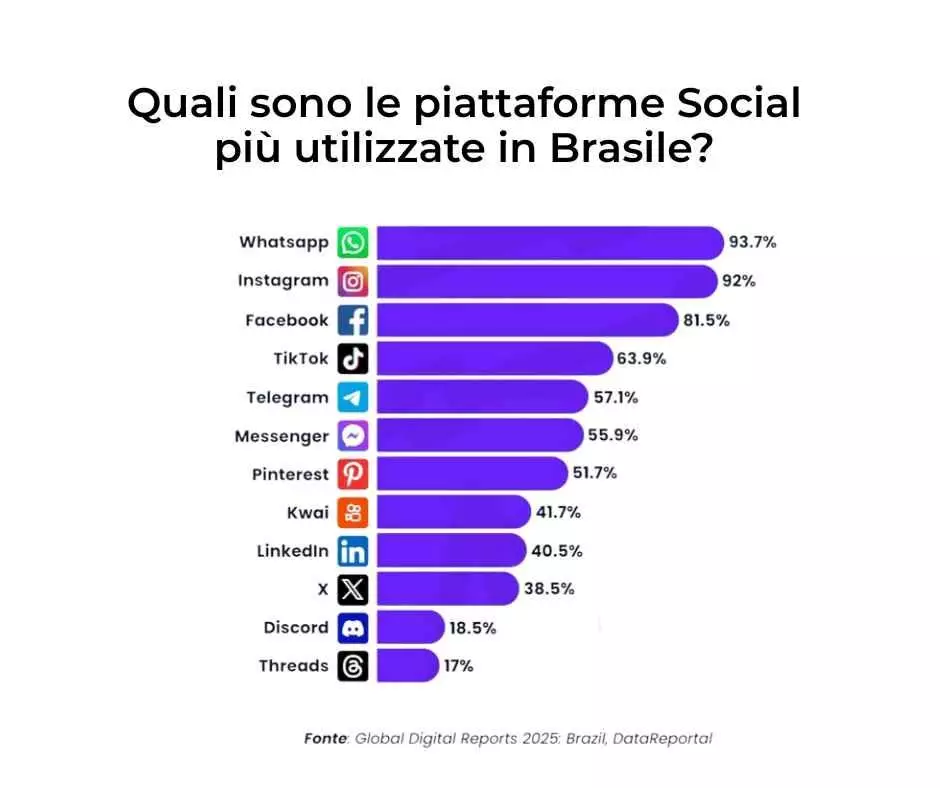
The Brazilian consumer journey is characterized by a strong integration between social media, search engines, and direct communication channels. In particular, WhatsApp and Google play a central role not only in customer relationships but also throughout the sales process.
To learn more about the digitalization of the export process in Brazil, you can read this article on our blog.
In this context, local marketing in Brazil relies on a seamless integration of channels. Instagram and YouTube are essential for capturing attention and generating interest, while WhatsApp serves as a key channel for closing sales, providing customer support, and building long-term loyalty. Google, through both traditional SEO and local SEO strategies, is crucial for capturing consumer demand at the moment of intent.
Several figures help illustrate this landscape. According to Statista, approximately 147 million people use WhatsApp in Brazil. In addition, research conducted by Opinion Box in partnership with Hedgehog Digital found that 93% of Brazilians use Google before making a purchase.
Influencers also play a significant role in local marketing in Brazil. Content creators act as trusted intermediaries between brands and consumers, helping companies adapt their communication in a more authentic and relatable way.
A Practical Example: 5 Steps to Adapt an Italian Marketing Campaign to the Brazilian Market
The first mistake Italian companies make when entering Brazil is assuming that translating their materials into Portuguese is enough. Adapting a campaign—whether traditional or digital—means rethinking it from the inside out, preserving the brand’s identity while communicating it through a completely different cultural lens. Here is a five-step framework to achieve this.
1. Conduct a Cultural Audit
Before changing a single piece of copy or imagery, companies need to understand who they are really speaking to. A positioning strategy that works in Italy may not carry the same symbolic value in Brazil. Moreover, which region should be targeted first? São Paulo, Rio de Janeiro, and the Northeast are emotionally and culturally distinct markets.
2. Localize the Tone of Voice
Brazilians tend to communicate in a warm, direct, and emotional way. Companies should move away from overly formal or institutional language, which is often perceived as distant rather than authoritative. Communication should foster a sense of personal connection, and the visual language should follow the same principle: vibrant colors, real people, and relatable situations.
3. Choose the Right Channels
Brazil’s digital ecosystem differs significantly from that of Europe. Companies should treat WhatsApp as a primary channel—not an optional one—for customer support, promotions, direct sales, and e-commerce. Instagram and YouTube dominate inspiration and entertainment, respectively. Any campaign aimed at driving sales should also highlight installment payment options (“parcelamento”), as the ability to pay in installments is an extremely powerful marketing message in Brazil.
4. Test with Local Audiences
Companies should never launch campaigns at scale without first testing them with members of their actual Brazilian target audience. Cultural biases are often invisible to those who carry them. A small-scale social media test with A/B variations in headlines and tone, combined with qualitative analysis of spontaneous comments, can provide more valuable insights than any structured survey.
5. Continuously Optimize
The Brazilian market is dynamic and heavily influenced by cultural events, football, and local holidays that do not align with the European calendar. Companies should work with local market expertise and maintain a fast creative cycle. Successful brands are often able to react to emerging trends within 24 to 48 hours.
The guiding principle is simple: the Italian campaigns that succeed in Brazil are not those that merely export a brand’s identity, but those that engage in a meaningful dialogue with the local culture. Translation replaces words; localization changes the way a company thinks about its audience.
Conclusion
Given the data on digital channels and consumer purchasing behavior in Brazil, it is clear that both cultural and digital adaptation are essential for Italian companies seeking to enter this market.
The success of marketing campaigns depends on a company’s ability to understand the Brazilian customer journey, integrate multiple channels, and adapt its communication style to be more direct, engaging, and relationship-oriented.
Local marketing in Brazil provides a structured path toward achieving these goals. By combining a strong brand identity with consumer-focused messaging, strategic influencer partnerships, and seamless integration across social media, direct communication channels, and search engines, companies can build a strong and results-driven market presence.
Rather than simply replicating European models, the real challenge lies in adapting strategies to balance global brand consistency with local relevance.